Can I just plug my EV into a 240V outlet?
Sometimes. Many EVs can charge from a compatible 240-volt receptacle, but the outlet and circuit must be suitable for the continuous charging load and installed correctly. Charging for hours can expose worn receptacles or undersized wiring. In the Twin Cities area, have a qualified electrician check the circuit before relying on it for Level 2 charging.
When can a 240-volt outlet work for EV charging?
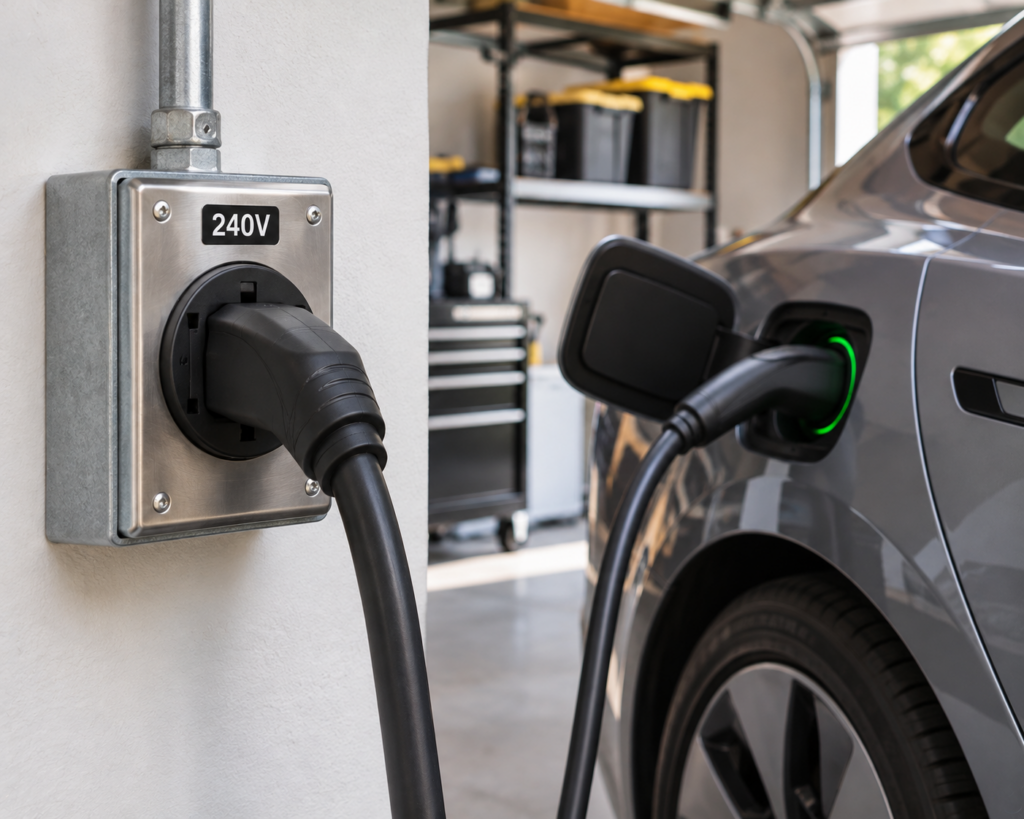
A 240-volt receptacle can support Level 2 EV charging when the vehicle uses a compatible cord set and the electrical circuit is designed for the charging load. The important point is that the presence of a 240-volt outlet does not, by itself, prove that the outlet is appropriate for an EV. The receptacle, wiring, breaker, grounding, and available electrical capacity all have to work together.
EV charging is different from briefly running a tool or appliance because charging commonly continues for hours. That long operating period makes the condition and sizing of the circuit especially important. A worn receptacle, loose connection, or wiring that is not appropriate for the load can become a concern even when the plug physically fits. A qualified electrician can evaluate the existing setup and determine whether it is suitable or whether a dedicated charging circuit is the better approach.
Why a dryer outlet is not automatically an EV charging outlet
A common shortcut is to look at an existing dryer receptacle and assume it can simply be shared with an EV. That is not a substitute for a dedicated charging circuit. A circuit intended for a dryer was designed around that appliance and its wiring arrangement. Adding regular vehicle charging or repeatedly swapping high-load equipment on the same circuit can create conditions the original setup was not meant to handle.
The safer decision is based on the circuit, not just the outlet shape. The electrician should verify the breaker size, conductor size, receptacle condition, required protection, and whether the home has enough electrical capacity for the charger. Extension cords should not be used to bridge the distance between the vehicle and the outlet.
EV charging considerations in the Twin Cities area
For homeowners in the Twin Cities area, the practical question is often where the vehicle parks and whether the existing electrical system can support charging in that location. Garage and outdoor charging arrangements can have different equipment and installation needs, so the charging equipment should be appropriate for where it will be used.
An electrical evaluation is also useful in homes where the panel is already serving several major loads. Some homes have adequate capacity for Level 2 charging, while others may need a new circuit or other electrical work. The goal is not to assume an upgrade is always necessary, but to verify the system before making EV charging a long-duration daily load.
Myth: Any 240-volt receptacle is ready for an EV
The myth is that voltage alone determines whether an outlet is safe for vehicle charging. In reality, a compatible 240-volt receptacle is only one part of the setup. The circuit must also be properly sized, protected, installed, and in good condition.
That is why plugging in first and evaluating later is not a good approach. If the outlet is worn, the wiring is undersized, or the circuit is shared in a way that does not suit continuous charging, the fact that the charger turns on does not confirm the installation is appropriate. A professional assessment can identify those issues before the outlet becomes part of a regular charging routine.
FAQ
Can I just plug my EV into a 240V outlet?
Sometimes. Many EVs can charge from a compatible 240-volt receptacle, but the outlet and circuit must be suitable for the continuous charging load and installed correctly. Charging for hours can expose worn receptacles or undersized wiring. In the Twin Cities area, have a qualified electrician check the circuit before relying on it for Level 2 charging.
Do all EVs use the same 240-volt plug?
No. EV charging equipment and receptacle configurations vary, so the cord set must be compatible with both the vehicle and the installed outlet.
Does Level 2 charging need a dedicated circuit?
A dedicated circuit is commonly used for Level 2 charging because the charger creates a long-duration electrical load. The specific circuit must match the equipment and installation.
Can I use an extension cord with an EV charger?
No. Extension cords should be avoided for EV charging. The charging equipment should connect to an appropriate receptacle or properly installed charging station.
What should an electrician check before I charge?
The electrician can check electrical capacity, breaker and conductor sizing, receptacle condition, required protection, and whether the existing circuit is appropriate for the charger.
Conclusion
Sometimes an EV can use a 240-volt receptacle, but the plug fitting is not enough to establish that the circuit is suitable. The outlet, wiring, protection, and available electrical capacity should match the charging equipment and its continuous load.